


Have you ever wished you could give your child a superpower? Not one of flight or invisibility, but a real, invisible tool they could use for the rest of their lives to think more flexibly, connect more deeply, and navigate the world with greater confidence. That superpower exists, and science shows one of the most effective ways to unlock it is through early childhood Spanish immersion.
Table of Contents
Many parents are curious about the benefits of a bilingual preschool, but wonder if it’s just a "nice-to-have" or a truly foundational advantage. The research is clear: exposing a child to a second language during their formative years is one of the most powerful forms of brain training you can provide.
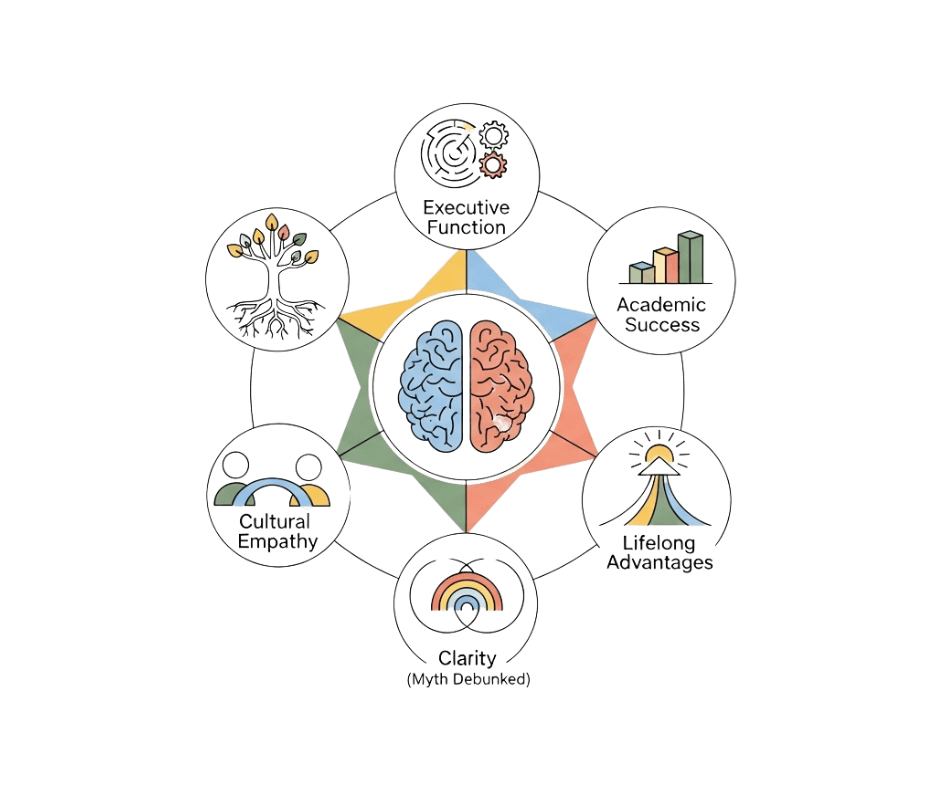
In this article, we’ll explore the five science-backed reasons why choosing a program focused on the cognitive benefits of bilingualism is one of the smartest investments you can make in your child's future.
1. It Supercharges Their Brain's "Executive Function"
Think of executive functions as the brain's "air traffic control system." They manage focus, memory, and the ability to switch between tasks. Research consistently shows that bilingual children have a significant edge in this area.
Because a bilingual brain is constantly, subconsciously managing two languages, it gets a continuous workout. This mental exercise strengthens the neural pathways responsible for cognitive flexibility, enhanced concentration, and superior problem-solving.
What this looks like in our classroom is the magic of multitasking. It's a child switching seamlessly between the spatial-relations task of building a complex block tower while processing a teacher's question in Spanish. This constant, gentle "brain-switching" builds a mental muscle that will serve them for life.
2. It Builds a Foundation for Long-Term Academic Success
The benefits of a bilingual preschool in Utah extend far beyond the playground. Large-scale studies have shown that bilingual students often outperform their monolingual peers in a variety of academic subjects, including math and reading comprehension.
How? By developing a greater metalinguistic awareness—a deeper, intuitive understanding of how language itself is structured. This powerful skill not only makes it easier for them to learn a third or fourth language later in life, but it also enhances their literacy skills in their native language. It gives them a structural advantage that pays dividends throughout their entire academic career.
3. It Develops Deeper Empathy and Cultural Intelligence
Language is more than words; it’s a bridge to understanding other cultures and perspectives. In our increasingly globalized world, the ability to connect with people from different backgrounds is not a soft skill—it’s an essential one.
Our early childhood Spanish immersion program is authentically bicultural. Children don't just learn Spanish words; they sing Spanish songs, read stories from Latin American authors, and celebrate cultural traditions. This process naturally fosters a higher level of empathy and an open, curious mindset, preparing them to be compassionate and confident global citizens.
The moment of true learning isn't when a child can name a color in two languages. It's when they realize that 'rojo' and 'red' both describe the same beautiful crayon, and that different people have different, equally valid ways of seeing the world. That is the beginning of empathy.
"Finding a place that not only provides excellent education but also honors and celebrates our culture has been a gift. Our son feels so proud of his heritage and speaks Spanish with his grandparents with a new level of confidence." — The Garcia Family
4. It Doesn't Cause Confusion—It Creates Clarity (The Myth, Debunked)
This is often the most important question for caring parents: "Will exposing my child to a second language confuse them or delay their English?"
It’s a common and completely valid concern. The wonderful news is that decades of scientific research have definitively shown the answer is no.
A young child's brain is not like a computer with limited storage; it’s like a muscle that grows stronger with use. The period from birth to age seven is an optimal window where the brain is uniquely wired to acquire multiple languages simultaneously and naturally.
At ABC Home Care, we use the proven "One Voice, One Language" (OPOL) method. Our Spanish-speaking educators interact with the children consistently in Spanish, and our English-speaking educators do so in English. This creates a clear, predictable, and stress-free environment where your child naturally associates a specific person with a language. Just as they know to speak one way to Grandma on the phone and another way to the family pet, they quickly and intuitively learn who their "Spanish person" and "English person" are.
A Note From Our Founder, Nayreth
"As a mother in a bilingual home, I've witnessed this magic firsthand. I've seen my own children’s eyes light up as they switch between languages to tell a story, effortlessly navigating two worlds. This isn't just a curriculum we teach; it's a reality we live. Bringing that gift of a second perspective to the children in our care, in a loving and supportive home, is the reason I started ABC. It is my personal passion."
5. It Unlocks Lifelong Health and Career Advantages
The investment in a bilingual education pays dividends for a lifetime, in ways you might not expect.
Professionally, bilingualism is a highly sought-after skill in the global marketplace, opening doors to better career opportunities and higher earning potential. But the benefits go even deeper. Groundbreaking studies have shown that lifelong bilingualism can build a greater "cognitive reserve," potentially delaying the onset of neurodegenerative diseases like Alzheimer's by an average of four years. It's truly a gift that keeps on giving.
Choosing a childcare program is about so much more than just finding a safe place for your child to be. It’s an opportunity to provide them with a foundational advantage that will shape their future. The science is clear: the bilingual brain is more flexible, resilient, and connected.


